
Tiger’s Nest and Bhutan
- Cooperation in Polarity and Equality
The cooperation between Tiger’s Nest, Taktsang Denmark and Bhutan is an unusual and unique encounter that bridges continents and vast differences in both language and culture.
It is a story about recognizing and acknowledging the distinctive spirit that lies beyond outward appearances. When we meet people who are different from ourselves, we often respond with an awkward curiosity, rejection, or perhaps even fear. But when we learn to look beyond appearances, a powerful and transformative meeting based on equality and polarity can emerge.
This is what happened when a modern Danish meditation centre in Eastern Jutland met a thousand-year-old Buddhist tradition in the Himalayas. It was an encounter of great impact.
Tiger’s Nest in Denmark underwent a profound transformation, discovering new concepts of consciousness and reshaping its self-understanding. Inspired to pursue a new path, it was empowered with the DewDrop Lineage. Furthermore, we discovered the true joy and value of spiritual festivals as a way of expressing gratitude and compassion for all sentient beings. The centre was also blessed with valuable insights and experiences from its cooperation with Bhutan and deeply honored by the endorsement from
The Central Monastic Body of Bhutan. In return, Bhutan experienced the great joy of passing on its treasures to the West.
This story began at the dawn of the new millennium and has continued to unfold through the following decades. Here, you can follow the story in the form of selected milestones.
2001 - Tiger’s Nest receives its name
One October morning in 2001, Anne Sophie Jørgensen awoke with a strong and clear impulse: her meditation centre was to be named Tiger’s Nest.
At that time, there was already a deep interest in Tibetan Buddhism and a recognition of its relevance for the practice at the centre. The group at Tiger’s Nest in Denmark soon discovered that there were several spiritual places around the world with the same name, the most famous being the Taktsang Monastery in Bhutan. The word “Taktsang” literally means Tiger’s Nest.
With the new name came a growing interest in Buddhist insights into consciousness. In 2003, a student from Tiger’s Nest travelled to Bhutan to visit Taktsang. At that time, however, it was difficult to gain access as a foreigner and a non-Buddhist, and she had to be content with seeing Taktsang from a distance.
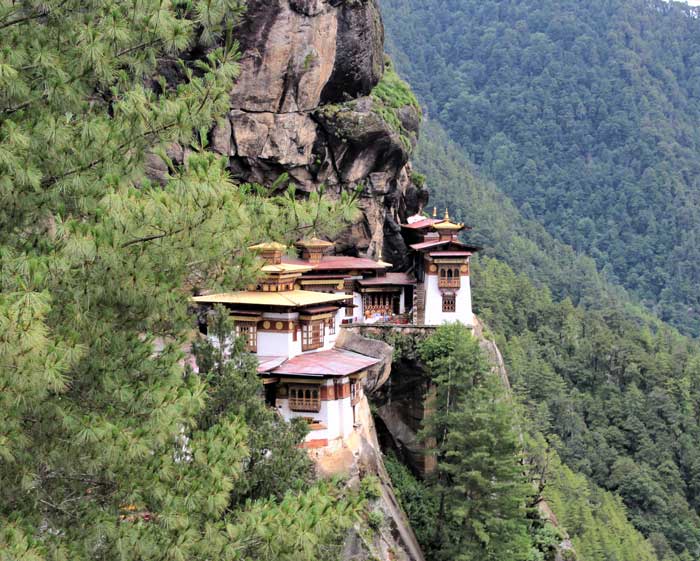
Facts about Paro Taktsang:
Taktsang in Bhutan is named Paro Taktsang and is located on a cliffside in western Bhutan’s Paro Valley. It was built in 1692. The monastery was constructed around the caves where Yeshe Tsogyal and Padmasambhava meditated in the 8th century. There have also been other monasteries in the Himalayas that have been called Taktsang.
Taktsang holds great significance for the country, both culturally and spiritually, and is also Bhutan’s largest tourist attraction.
2007 - Anne Sophie meets Lama
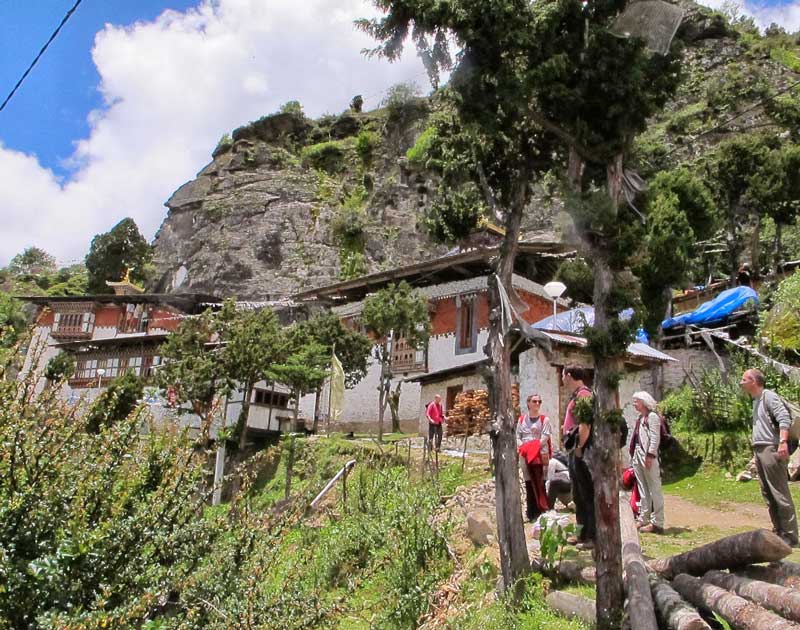
In 2007, Anne Sophie Jørgensen traveled to Bhutan with a friend to see the country and, most importantly, the monastery of Taktsang. After a long, steep climb, they were able to enter the ancient buildings.
However, the true highlight of the trip happened at another famous monastery, Chodrak. The head lama, Tshewang Rinzin, showed the guests around and unexpectedly, he invited the two Danish women to stay the night – a very unusual gesture they were happy to accept.
That night, Lama Tshewang Rinzin dreamt of Anne Sophie: “where she meditates, the mountains are always covered in snow.” Yet he did not tell her about the dream, and she returned home unaware that a profound spiritual connection had been formed. This relationship would last until the lama’s death in the winter of 2023, bringing great change and renewal to both of them.
In the years that followed, as several of Anne Sophie’s students traveled to Bhutan, it became clear that Lama Tshewang Rinzin had recognized Anne Sophie’s meditation and perceived its spiritual qualities. As he told one of her students:
“She is not a Buddhist, but she is a great Buddhist teacher.”
Facts about Chodrak:
The Chodrak monastery is situated at an altitude of 3,600 meters in Bumthang, central Bhutan. The first monastery on this site was built in 1234. It was built against a sacred rock, where Padmasambhava is believed to have meditated in the 8th century.
2011 – Lama visits Tiger’s Nest
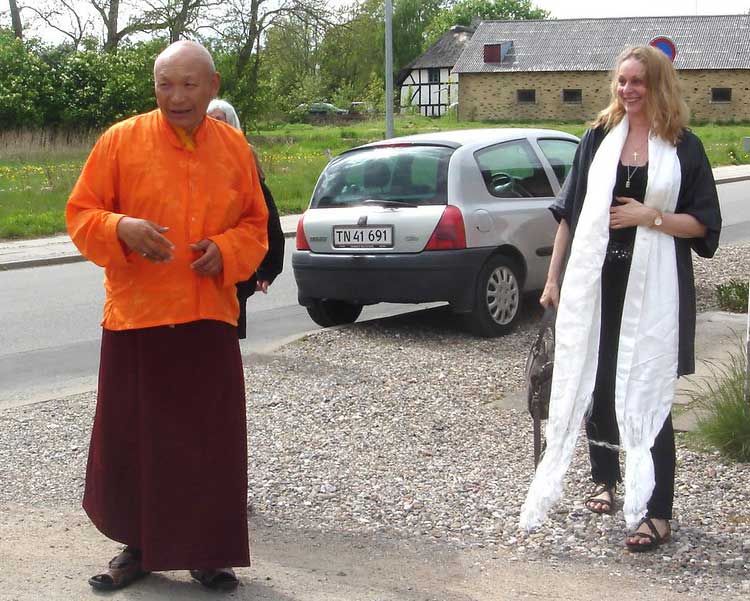
Lama Tshewang Rinzin was invited to visit Tiger’s Nest, and he came to Denmark for the first time in May 2011.
It became a profound and decisive experience for everyone at Tiger’s Nest. Lama Tshewang Rinzin travelled with a translator and guide from Bhutan, as he did not speak English and had never before journeyed so far. Through the interpreter, Lama expressed that he sensed a meaningful spiritual connection between Tiger’s Nest and Bhutan.
Lama was particularly attentive to Anne Sophie’s karmic connection with Yeshe Tsogyal, a female central figure in Buddhism. Together with Padmasambhava, Yeshe Tsogyal helped to found Tibetan Buddhism in the Himalayas back in the 8th century.
Lama spoke of the distinctive signs of this connection, which he had noticed in his meeting with Anne Sophie, her students, and Tiger’s Nest. He also drew several parallels between Anne Sophie’s teaching and Buddhist doctrine.
Lama was intrigued by the life and the community at Tiger’s Nest. He curiously asked about the spiritual practice: “How do you practice emptiness?”
During his visit, Lama attended a high mass in Aarhus Cathedral. Here Lama and Anne Sophie participated in communion together and received bread and wine side by side from the priest. This became a beautiful highlight of the visit. It was experienced almost as a symbolic tantric union of East and West and thus as a union of the two karmic roots at Tiger’s Nest: Christianity and Buddhism.
Many friendships and spiritual bonds were forged between Lama and the students at Tiger’s Nest, and Anne Sophie and Jukas were invited to visit Bhutan already the following year.
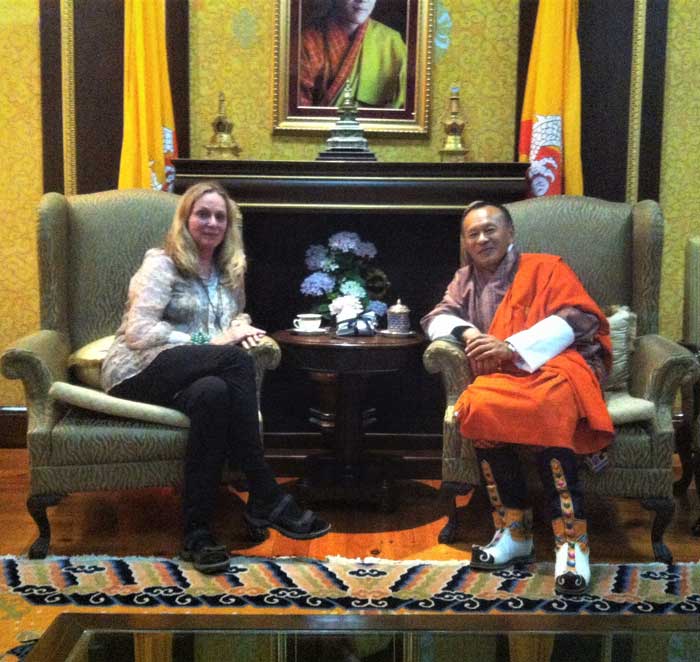
Anne Sophie Jørgensen og Jigme Thinley
2012 – Taktsang Denmark
In 2012, once again, Anne Sophie Jørgensen travelled to Bhutan, this time together with her partner Jukas Killemose. On this journey, among other things, Anne Sophie was invited to meet the country’s then Prime Minister, Jigme Thinley.
The journey had been arranged by Lama, and naturally they were also to visit Taktsang. Here Anne Sophie met the senior lama of the monastery. When Lama Tshewang Rinzin introduced the two spiritual teachers to one another, he expressed with his characteristic humour how happy he was to be sitting together with not one but two Taktsang lamas.
On the way down from Taktsang, Lama suggested to Anne Sophie that Tiger’s Nest added Taktsang Denmark to its name. After all, it is a Taktsang – or, as Lama Tshewang Rinzin put it:
“Tiger’s Nest is a Taktsang for the West.”
A Taktsang is a centre of spiritual power, a place where people experience, study, and cultivate consciousness, and where consciousness may take a leap. Lama’s suggestion was therefore a great recognition, though also a weighty responsibility. Two years passed before Tiger’s Nest was ready to take that next step and become Tiger’s Nest, Taktsang Denmark.
2013 – The first travel group
In 2013, Anne Sophie Jørgensen once again travelled to Bhutan together with Jukas Killemose. This time they were accompanied by a group of 14 students from Tiger’s Nest.
They had been invited to participate in the annual festival at Chodrak, where Anne Sophie six years earlier had stayed overnight during her first visit to Bhutan. Lama Tshewang Rinzin was still the senior lama of the monastery.
A Buddhist festival is a spiritual celebration lasting several days, intended to preserve the connection to the Buddhist deities and to protect against evil spirits. A senior lama leads the ceremonies, which consist of various rituals, music, and powerful dancers. Day and night, prayers and mantras are recited in the temple. Not even at night does one experience silence, as the young monks take turns chanting “Om mani peme hung.”
Ordinary people from the local area also come to participate in the festivities, and rice dishes and butter tea are served to everyone.
Participating in this annual festival, Chodrak Drubchen, was a profound spiritual experience for the Danish guests. It was also physically demanding, with constant activity, long hours in a cross-legged position, and the effects of the thin mountain air.
Of course, the travel group also had to visit Taktsang. The monastery is built around a sacred cave where Yeshe Tsogyal and Padmasambhava meditated and practiced in the 8th century. This cave is only opened once a year, and the date is revealed only the day before.
To everyone’s surprise and joy, the cave was opened precisely on the day the travel group visited Taktsang. It was a truly unique opportunity to approach one of Taktsang’s greatest sanctuaries. Also Lama Tshewang Rinzin was deeply moved and grateful as he had never before visited the cave. For him, it was another confirmation of the connection between Taktsang in Bhutan and Tiger’s Nest. He expressed:
“The flower you have at the centre, the seed was planted in Bhutan.”
Anne Sophie Jørgensen was recognised as a spiritual teacher from Tiger’s Nest, Taktsang Denmark, travelling with a group of her students. She and the travel group experienced a strong connection between Tiger’s Nest and Bhutan, and they also felt that the name Tiger’s Nest, Taktsang Denmark was real and important – it was meant to be used, also back home in Denmark.
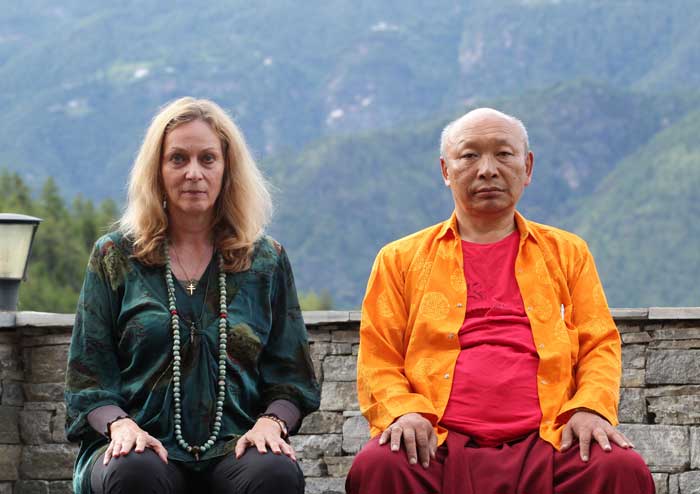
Anne Sophie Jørgensen og Lama Tshewang Rinzin 2013
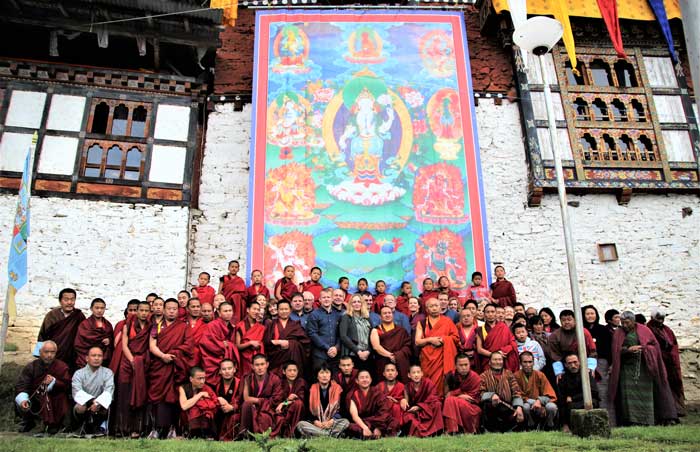
2015 – The stupa is built
In 2015, Anne Sophie, Jukas, and a new travel group of 14 students went to Bhutan. As well as on the journey in 2013, they were to participate in the annual festival at Lama’s monastery, Chodrak, where they were given the status of honoured guests. The travel group brought a gift from Tiger’s Nest in the form of a giant thangka depicting the deity of compassion, Chenrezig. The thangka was hung on the outer wall of the monastery, facing the valley.
Before the journey, Je Khenpo had asked Anne Sophie’s students to recite two mantras and to count how many times they were recited. These were “Om mani peme hung”, attributed to Chenrezig, the Buddha of Compassion, and “Om ah hung benza guru pema siddhi hung”, Padmasambhava’s mantra. This way to work with mantras was unfamiliar to the students, yet interesting. Many students undertook the task and thus completed it successfully.
The new travel group was inspired to contribute with their own small ceremonial prayer, a so-called puja. The students had observed the Buddhist pujas, in which the monks chant mantras. The students had prepared a Danish version. The puja consisted of a Danish mantra from Tiger’s Nest, the name of which could be translated to “Compassion is Wisdom, Wisdom is Compassion”, sung in harmony, then a Danish hymn, and the two Buddhist mantras mentioned before. Now the students could contribute with this puja at the monasteries and elsewhere during their journey. This made a strong impression on the Bhutanese hosts.
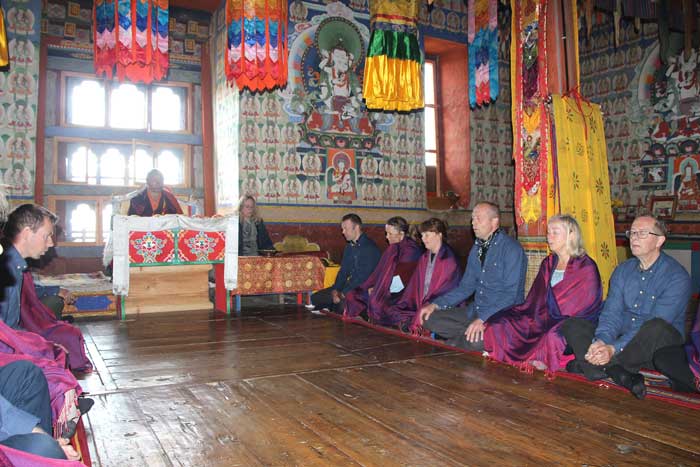
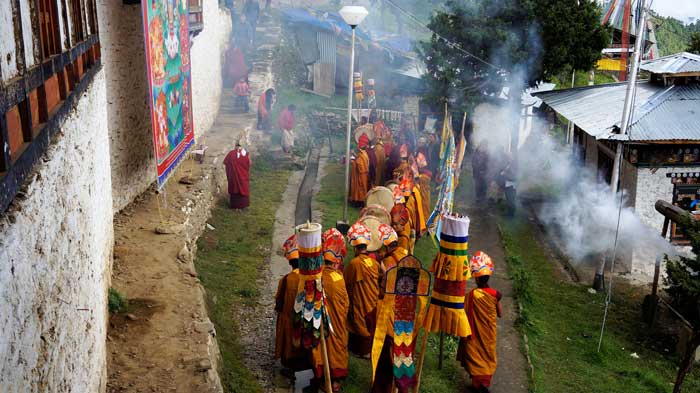
The festival at Chodrak was, as before, colourful, with dancers, music, and Buddhist rituals. Once more, the travel group sensed that the spiritual essence behind the rituals was not so different from the essence of the spiritual practice at Tiger’s Nest.
After the festival, the group from Tiger’s Nest performed their puja in the temple at Chodrak, and many monks and local people accepted the offer to be blessed by Anne Sophie afterwards. Later, this puja was also performed at Taktsang.
During the trip, much time was spent reviewing drawings of the stupa, which Lama, the year before, had encouraged Tiger’s Nest to build. Constructing a stupa is a special, ritual action, and many instructions had to be given. Many sacred objects needed to be purchased to place inside the stupa, and it also had to be consecrated by a senior religious figure.
The travelling group had barely returned home before the first spadeful of earth was dug for the construction of the stupa.
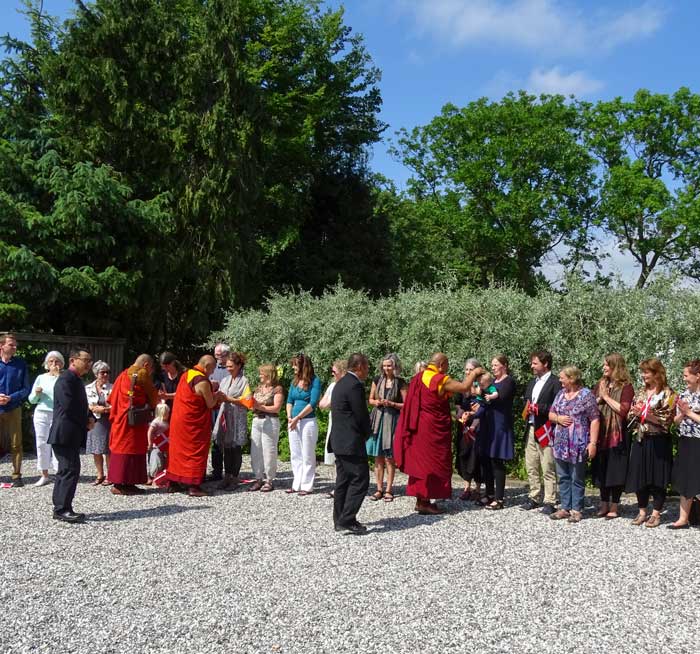
H.E. Dorje Lopens ankomst til Tigerens Rede 2016
2016 – His Eminence Dorje Lopen consecrates the stupa
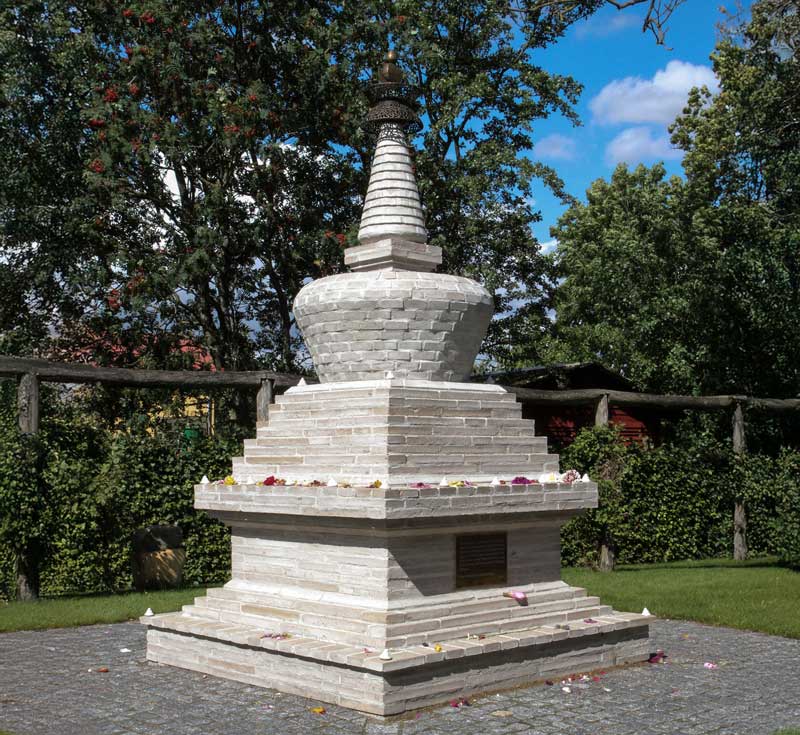
The stupa was completed in 2016 after many months of construction, with various rituals performed along the way. It was built according to the best Buddhist guidelines, combined with a clear Nordic expression. Much of the stupa’s contents were also adapted to Nordic life and the practice at Tiger’s Nest.
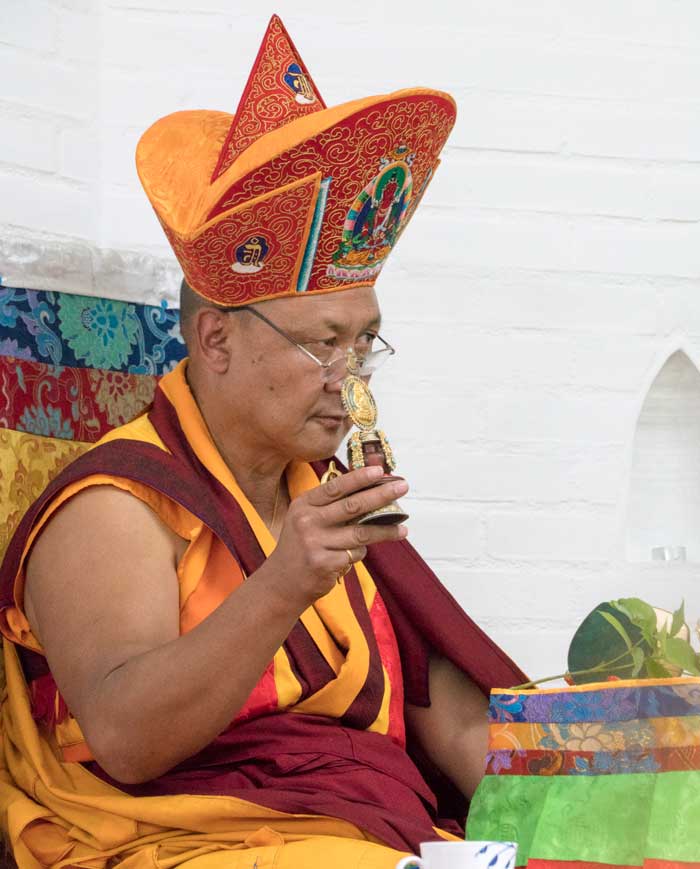
Tiger’s Nest received an official visit from Dorje Lopen in June 2016. Dorje Lopen is the second-highest religious authority in Bhutan. He arrived together with Lama Tshewang Rinzin, two monks, and a representative from the Bhutanese embassy in Brussels. Tsewang Lhundup, a Bhutanese resident in Denmark, was also present.
The visit was arranged in collaboration with the Bhutanese government and its embassy in Brussels. This visit was undoubtedly a highlight in the contact between Tiger’s Nest and Bhutan.
An official welcoming reception was given at the community hall in Gedved, where local residents could meet the Bhutanese guests. The event received great support. The press, the chairman of the local council, and a member of Horsens Municipality council attended as well. The latter emphasised that the visit from Bhutan could enrich dialogue and cooperation across cultures and religions. He highlighted Gedved as a place with dedicated people and mentioned Tiger’s Nest and Anne Sophie Jørgensen’s work as significant.
On the second day of the visit, Anne Sophie shared with Dorje Lopen a strong vision she had experienced the previous night, and he replied that a new lineage had begun in Denmark. This was perceived as a landmark event. This new lineage, initiated by Anne Sophie, would later be named The DewDrop Lineage.
Dorje Lopen stated that he recognised Anne Sophie’s work. She is neither a traditional Christian nor Buddhist, but teaches independently of religious traditions – adapted to the present and Western culture.
Consecration of the stupa
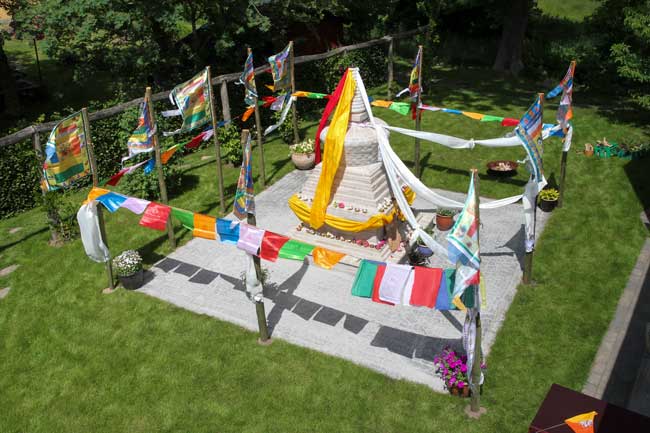
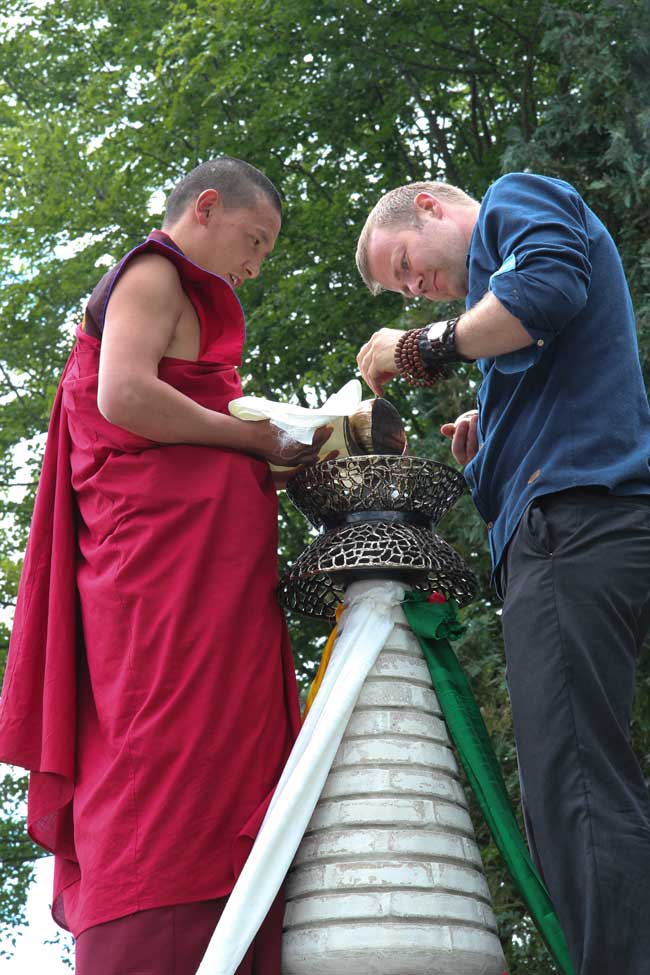
On the third day of the visit, the newly built stupa was to be consecrated. The guests had brought flags and decorations for the occasion.
The consecration began with a purification of the surroundings. Dorje Lopen, Lama Tshewang Rinzin, Khenpo, and Lopen Zeko performed a puja, reciting prayers and mantras alternated with the use of bells.
Khenpo sprinkled drops of saffron water around the DewDrop Hall, which is the big meditation hall at Tiger’s Nest. Dorje Lopen then filled the top of the stupa with carefully selected relics and Buddhist texts. Afterwards, Jukas Killemose and Lopen Zeko helped each other place the top on the stupa.
Meanwhile, Dorje Lopen conducted another puja in the DewDrop Hall, filling the room with chanting voices, the beat of a damaru drum, and other musical instruments.
Then everyone sang the Bhutanese prayer “Jigten Wangchuk,” and finally the stupa was blessed with rice, sand, water, and flower petals.
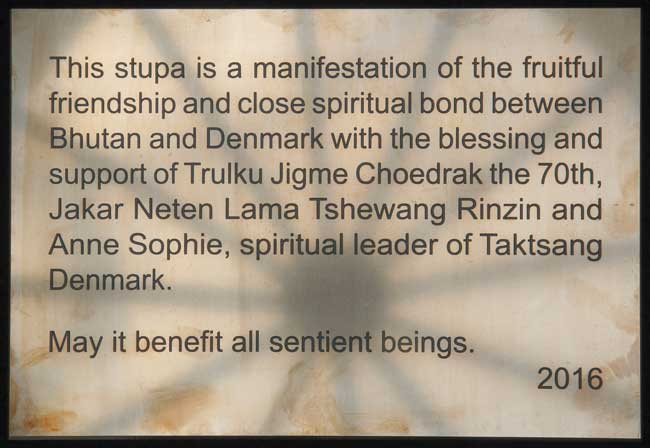
The consecration of the stupa took place with the blessing of Je Khenpo, whose full name and title is H.H. Trulku Jigme Choedrak, the 70th Je Khenpo of Bhutan.
Empowerment
During the visit, Dorje Lopen and his accompanying monks conducted a blessing ritual for the students at Tiger’s Nest. Dorje Lopen called it an empowerment, or more precisely: “Empowerment of Buddha Amitayus, or the Buddha of long life, embodiment of all the Divinities.”
According to Dorje Lopen and his team, the purpose of the ritual was to bless those present at Tiger’s Nest with compassion, a long and happy life, and to remove obstacles so that everyone could spread love, peace, and prosperity in the world.
An empowerment can be translated as a transmission of power, which according to Dorje Lopen, occurs when the recipient has a pure heart, a clear mindset, and makes themselves available to serve humanity.
Dorje Lopen blessed all the participants, who also received a little traditional blessed red ribbon.
Dialogue Day and Compassion Event
During the visit, Tiger’s Nest, in collaboration with the Christian interfaith organisation IKON, held an Interfaith Dialogue Day. People from other spiritual centres were invited, allowing Danish Christians, Buddhists, and others to meet the Bhutanese guests to exchange experiences regarding spirituality and practice.
The following day, a large World Compassion Event was held in Copenhagen. The panel participants were Dorje Lopen, Bishop Peter Fischer-Møller, and Anne Sophie Jørgensen. Each gave a short talk, after which questions were taken from the 180 people in the audience. It was moving to feel a shared understanding of compassion.
One participant later stated:
“There was a flow between talks, meditation, song, and rituals, which made the evening lively and enriching. I left with the feeling that ‘it works’. I experienced that compassion was both cultivated and practiced.”
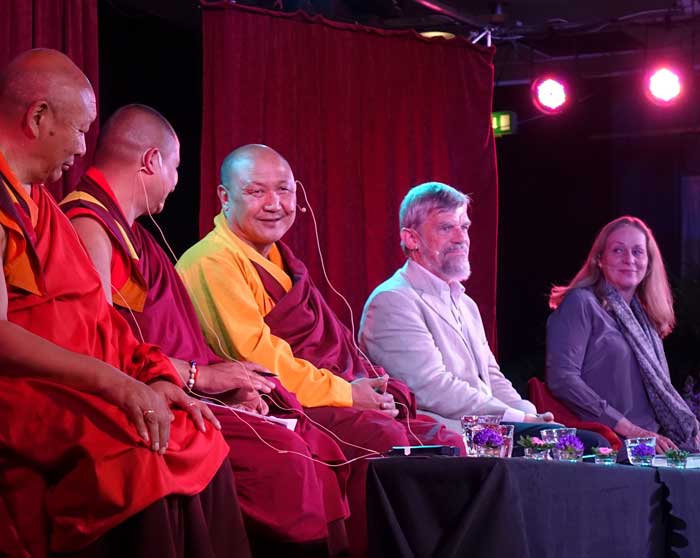
From left: Lama Tshewang Rinzin, Khenpo Sonam Bumdhen, H.E. Dorje Lopen, Peter-Fischer-Møller and Anne Sophie Jørgensen.
Letter of Acknowledgement
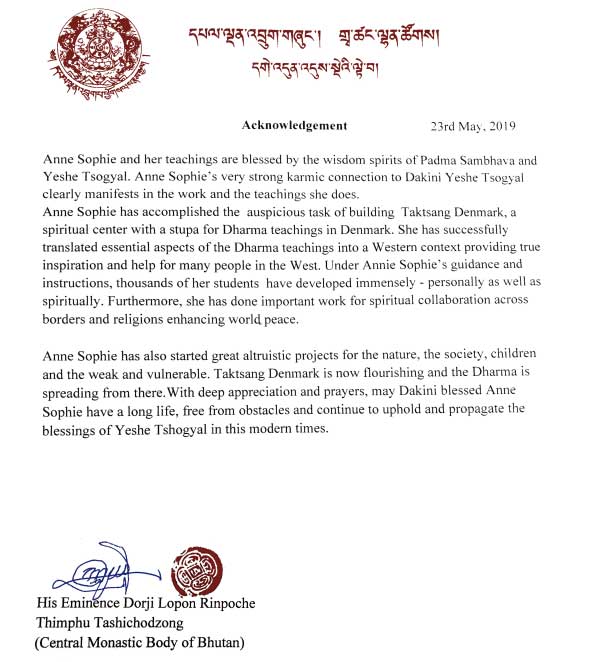
Over the years, Anne Sophie Jørgensen and Tiger’s Nest have received several letters from Je Khenpo and Dorje Lopen, recognising her work and supporting Tiger’s Nest. In 2019, a particularly important letter titled Acknowledgement arrived.
The letter acknowledges the spiritual work at Tiger’s Nest and emphasises Anne Sophie’s karmic connection with Yeshe Tsogyal. The letter was received with a deep gratitude for the rewarding collaboration and pleasure in being seen and recognised.
Read the letter here.
2023 – Lama’s death
On 22 December 2023, the announcement was made that Lama Tshewang Rinzin had passed away after a short time of illness.
Lama Tshewang Rinzin chose to remain in monastic life throughout his life to help others. For many years, he was a lama at Chodrak, and from 2016 to 2022 he served as Lam Neten at Jakar Dzong in Bumthang, the senior lama of the Bumthang district.
He was a respected authority who contributed with a driving force and renewal, and he meant a great deal to many people. He always worked to improve the living conditions of both monks and ordinary people in the local communities in Bhutan.
On the same day as the cremation, the stupa at Tiger’s Nest was decorated with candles in memory of Lama. His significance for Tiger’s Nest is immense, and he will always live on in the hearts of all who knew him.
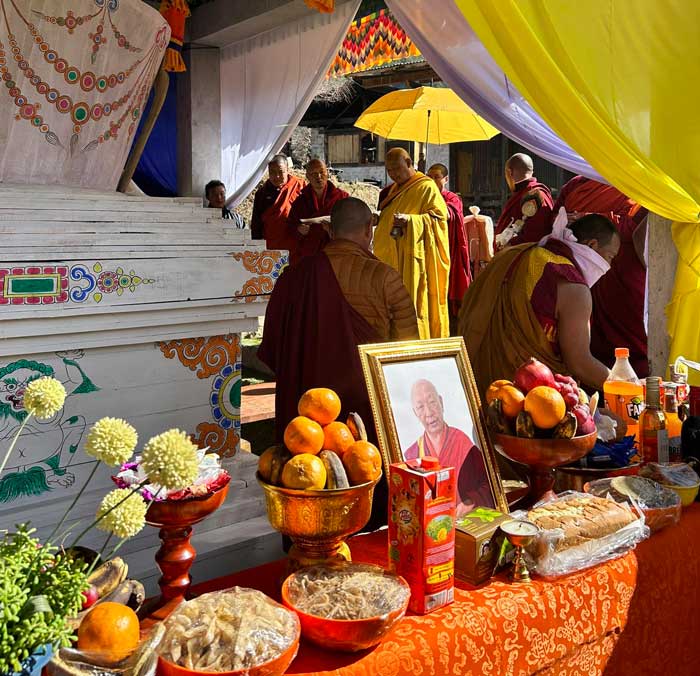
Lamas kremering i Bumthang blev forestået af H.E. Dorje Lopen.
2024 – Letter from Dorje Lopen
In 2024, Anne Sophie received another letter from Dorje Lopen.
The letter is a heartfelt appreciation of Anne Sophie’s work in conveying compassion and wisdom in a world that needs those qualities more than ever.
The letter once again emphasizes the special connection between Anne Sophie and Bhutan and the inside of Buddhist wisdom, especially her connection to the Buddhist Dakini Yeshe Tsogyal.
The letter can be found here.
Contact information
Tigerens Rede, Taktsang Denmark
Vestervej 4a
DK-8751 Gedved
Denmark
CVR: 21509973
Email: kontor@tigerensrede.dk
Related websites
The main page of Tiger’s Nest, Taktsang Denmark (in Danish)
The main page of Anne Sophie Jørgensen (in Danish)
https://annesophiejørgensen.dk/
The main page about the cooperation between Bhutan and Tiger’s Nest, Taktsang Denmark (mainly in Danish)